| |  | | | | In this issue | | | ACES Research Center: Advancing Scholarship. Expanding Impact As the counseling profession navigates increasingly complex challenges across higher education, practice, and policy, the ACES Research Center launches as a new infrastructure for scholarly development, offering consultation, project support, and training designed to strengthen research capacity across all stages of a scholar's career. Explore how the Center can support your work, from methodology and manuscript development to grant writing and dissemination. Read more to meet our team and learn how to get involved. | | | 2026 ACES Research Grants: Request for Proposals ACES is pleased to announce $100,000 in available funding across 3 to 5 exemplary research projects, plus a special $5,000 grant from Intelligent Video Solutions focused on technology-assisted clinical skills acquisition. Proposals are invited in areas including research training and impact, technology in counselor education and supervision, and suicide prevention and crisis counseling models. Read more to review eligibility, guidelines, and how to apply before the September 30 deadline. | | | ACES Seeks Officer Candidates ACES is seeking candidates for the following elected positions to begin July 1, 2027: - President (serves President-Elect 2027-2028, President 2028-2029, Past-President 2029-2030
- Member-at-Large for DEI (serves MAL-Elect 2027-2028, MAL 2028-2029, Past-MAL 2029-2030)
- ACES Graduate Student Elect (serves as Grad Student-Elect 2027-2028, Grad Student Representative 2028-2029)
ACES Bylaws allow for two pathways for consideration on the primary ballot. - Sponsorship by ACES Region — each Region can sponsor one candidate to be on the primary ballot considered by the ACES Governing Council (two candidates from the primary ballot proceed to the election). If you select sponsorship by the ACES region, application materials will be screened for basic eligibility prior to being forwarded to your Regional ACES Board for consideration.
- Petition — members can submit application materials including a petition endorsed by at least 50 active ACES members. The petition should include full names and ACES Member ID numbers. Candidates using the petition route may wish to use a survey platform to gather this information. If you select the petition route, your application materials will be screened for basic eligibility prior to being forwarded to the ACES Nominations & Elections committee for consideration.
Completed nominations for the positions listed in this announcement must be submitted by September 20, 2026 For more information, review the Nominations and Elections criteria information at this link: Nomination_and_Election_Criteria_2027.docx | | | ACES and NBCC Announce New Leadership and Expanded Research Initiatives| ACES and NBCC Collaboration |
 ACES and NBCC are pleased to announce a new collaborative leadership opportunity focused on advancing research, policy, advocacy, and workforce development across the counseling profession. Beginning September 1, Dr. Maribeth Jorgensen will serve as Interim Executive Director of NBCC’s Policy, Advocacy, and Research in Counseling (PARC) Center and as the inaugural Director of the ACES Research Center. Learn more about this important next step in strengthening research capacity, supporting member scholarship, and fostering data-informed initiatives that advance counselor education and the profession. | | | Advertisement  Tmind AI offers a risk-free, experiential training platform. Professors or clinic owners can create AI client profiles, customize evaluation rubrics, and use AI to provide targeted feedback. Learners will engage with AI-driven simulations to sharpen clinical skills and improve confidence. Learn more → |
| | | Upcoming ACES Webinar Series| September 18, 2026 | | | | 1:00 pm EST |
 The Triadic Relational Supervision Model: Integrating AI in Counselor Education and Supervision The integration of artificial intelligence (AI) in counselor education and supervision is transforming traditional dyadic supervision relationships into complex triadic systems. The Triadic Relational Supervision Model (TRSM) provides a framework for understanding how supervisors, supervisees, and AI systems interact within a shared supervision alliance characterized by transparency, safety, trust calibration, and reflective learning. Nested within a broader Human-AI Relational Theory, the TRSM parallels the Triadic Therapeutic Alliance (TTA) model for clinical practice to understand alliance formation with AI systems. This webinar introduces counselor educators and supervisors to the TRSM, which is grounded in alliance theory, attachment theory, and human-computer interaction research. Participants will explore the three primary dyadic relationships within the model: the supervisor-supervisee alliance, the supervisee-AI bond, and the supervisor-AI calibration dyad. The webinar examines how these relationships intersect to create a shared supervision alliance that enhances learning outcomes while maintaining ethical integrity. Attendees will learn practical strategies for integrating AI tools in supervision contexts. The presentation addresses critical ethical considerations such as confidentiality, data privacy, informed consent, cultural responsiveness, and algorithmic bias, ensuring alignment with the ACA Code of Ethics and ACES Best Practices in Clinical Supervision. The webinar emphasizes anti-racist practices and multicultural competencies by examining how values influence supervisee engagement with AI systems and how supervisors can maintain equity in technology-mediated supervision. Participants will gain competencies in digital literacy, trust calibration, and reflective technology use, preparing them to lead AI-integrated supervision that preserves relational depth, supports diverse learners, and advances social justice in counselor education. | | | Call for ACES Teaching Practice Briefs (TPB) Co-Editor The ACES Teaching Practice Briefs (TPBs) are concise summaries that provide practical guides describing pertinent topics in teaching and learning for use in counselor education classrooms. TPBs provide innovative, anti-racist, socially just, and evidence-based teaching and learning practices to promote quality instruction for all learners. Specifically, goals for TPBs include contributing to brave/critically reflective and inclusive classroom environments, creating curriculum that promotes learner cognitive complexity and critical thinking, and strengthening excellence in counselor education programs. The Briefs are intended to provide counselor educators with (1) easily accessible quick reference guides on a variety of topics pertaining to teaching strategies, learning environments, and the translation of community engaged practices to classroom settings; and (2) best-practices and innovative ideas for counseling andragogy from within counselor education and across educational or helping disciplines. ACES is recruiting candidates to serve as Co-Editor of the TPBs alongside co-editor Dr. Susan Branco. The TPB co-editor will receive a yearly honorarium of $500 for each year of their 3-year term. Qualifications, responsibilities, and application requirements are listed below. Required Qualifications: - Demonstrated commitment to social justice, equity, inclusion and intersecting cultural identities through teaching, research, and service.
- Must identify as a counselor educator. Candidates must have a degree in counselor education or have been employed full time as an instructor or faculty member in a counselor education program for at least one year prior to 2023 and currently be teaching in a counselor education program.
- Demonstrated experience with editorial board work or editor work.
- Evidence of quality teaching and supervision of master’s and/or doctoral students.
Preferred Qualifications - Documented publications pertaining to andragogy, curriculum, and/or evidenced-based teaching.
- Documented engagement with the profession including conference presentations and committee work around the topics of teaching and learning- especially from an anti-racist perspective.
Roles and responsibilities of the TPB editor: - Serve for three years in the position. (October 1st, 2026 through September 30th, 2029)
- Respond to authors of potential briefs.
- Collate briefs for distribution to the editorial board.
- Communicate with the editorial board including facilitating evaluations and recommendations of briefs by the board.
- Provide updates to the ACES governing council regarding the status of the briefs.
- Liaising with the ACES website coordinator for posting of briefs.
Application Requirements - Statement detailing the following:
- evidence of current and ongoing commitment to advocacy, social justice, anti-racism, and intersecting cultural identities within counselor education.
- experience related to editorial work (editor and/or board member).
- experience teaching and/or research related to teaching practices in counselor education.
- Letter of interest - including interest in serving on the TPB board if not appointed as editor.
Applications should be combined into one PDF and sent to search committee chair, Dr. Shawn Spurgeon @ presel@acesonline.net by September 8th, 2026 | | |  Special Issue VIII, Navigating Teaching in Challenging Political Times, of the Teaching Practice Briefs has been published! It is available on the ACES website now at https://acesonline.net/tpb-publication/. This issue includes brief, practical summaries of innovative teaching strategies specifically to address frequent challenges, increased restrictions, and unpredictable barriers to teaching. We encourage all counselor educators to read and consider incorporating the approaches presented in their own classrooms when appropriate. | | | Advertisement  | Promoted by Divine Mercy University |
Learn more → |
| | | CE&S: Article of the Week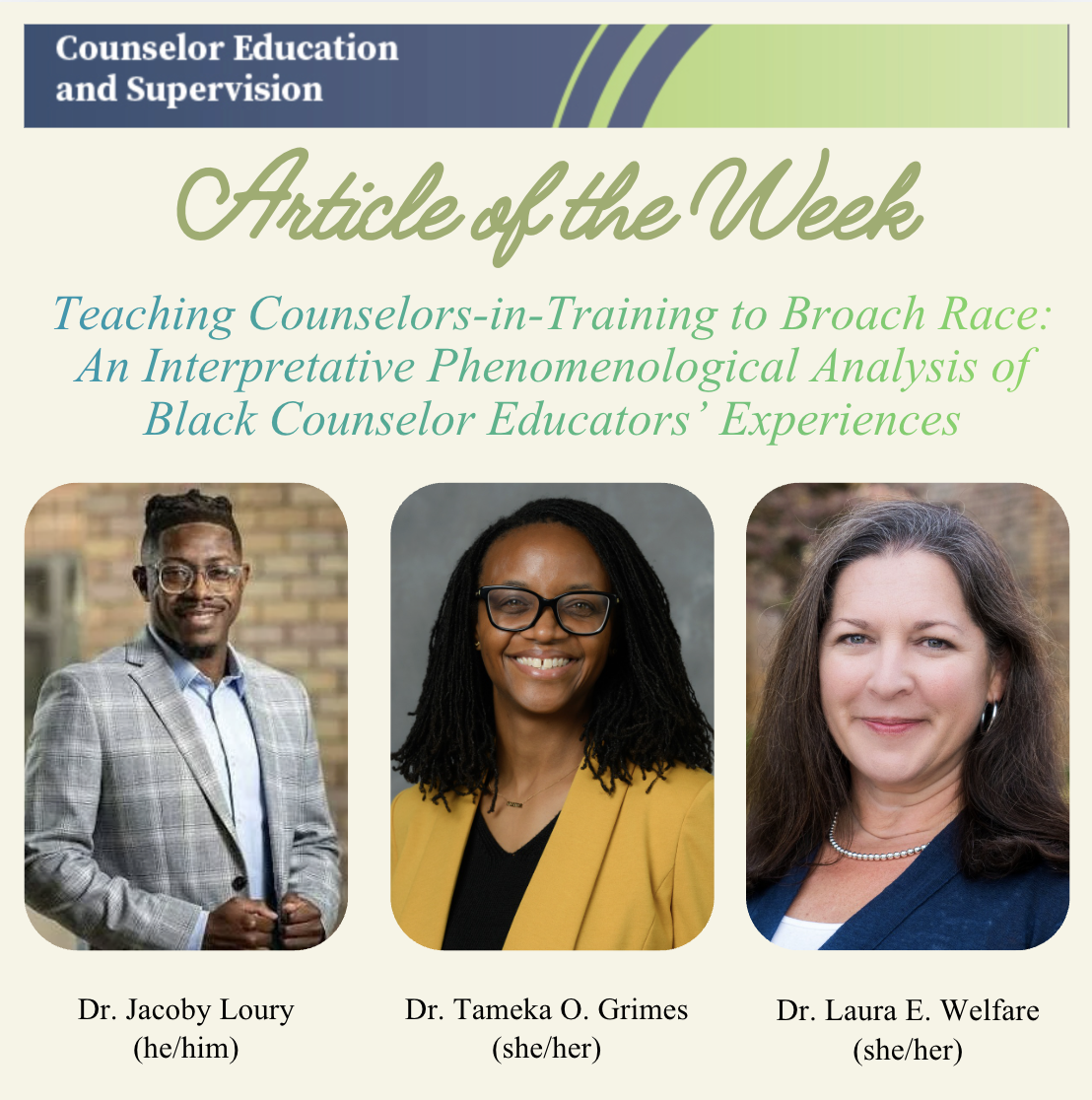 Meet the Authors Abstract Although broaching race in counseling is recommended across curricula, little research has examined how counselor educators prepare counselors-in-training to broach. This qualitative study used interpretative phenomenological analysis (IPA) to explore the lived experiences of nine Black counselor educators in CACREP-accredited counseling programs. We conducted semistructured interviews and analyzed the data using a seven-step process, discovering five themes. Five group experiential themes emerged: (a) Degree of Multiculturalism in Counseling Program, (b) Defining Broaching, (c) Centering Clients’ Culture, (d) Intentionally Discussing Race, and (e) Feeling Tension with Students. Findings highlight pedagogical approaches, relational tensions, and structural contexts that shape how Black counselor educators prepare counselors-in-training to broach race with clients, with implications for counselor education and practice. Words from the Authors - Dr. Jacoby Loury (he/him): “Effectively broaching race, ethnicity, and culture requires nuance and the willingness to explicitly address the elephant in the room. By centering the experiences of Black counselor educators, this study offers guidance for teaching one of counseling's most essential, yet often avoided, clinical skills.
- Dr. Tameka O. Grimes (she/her): “Our research was an important way to bring missing voices into the pedagogy conversation, and as a Black woman counselor educator I was curious to learn ways others were navigating these vital teaching responsibilities during such a tenuous political climate.”
- Dr. Laura E. Welfare: “I was honored to learn from these voices and Drs. Loury and Grimes throughout this project.”
Read More Loury, J., Grimes, T., & Welfare, L. (2026). Teaching counselors‐in‐training to broach race: An interpretative phenomenological analysis of black counselor educators’ experiences. Counselor Education and Supervision, 65(2), 176–185. Read More |  Counseling simulations trusted by 200+ institutions simcare.ai |
|
|